
Exporting Benefits from AI

Export.ScotlandWeb3.com

GTIN Token Utilization
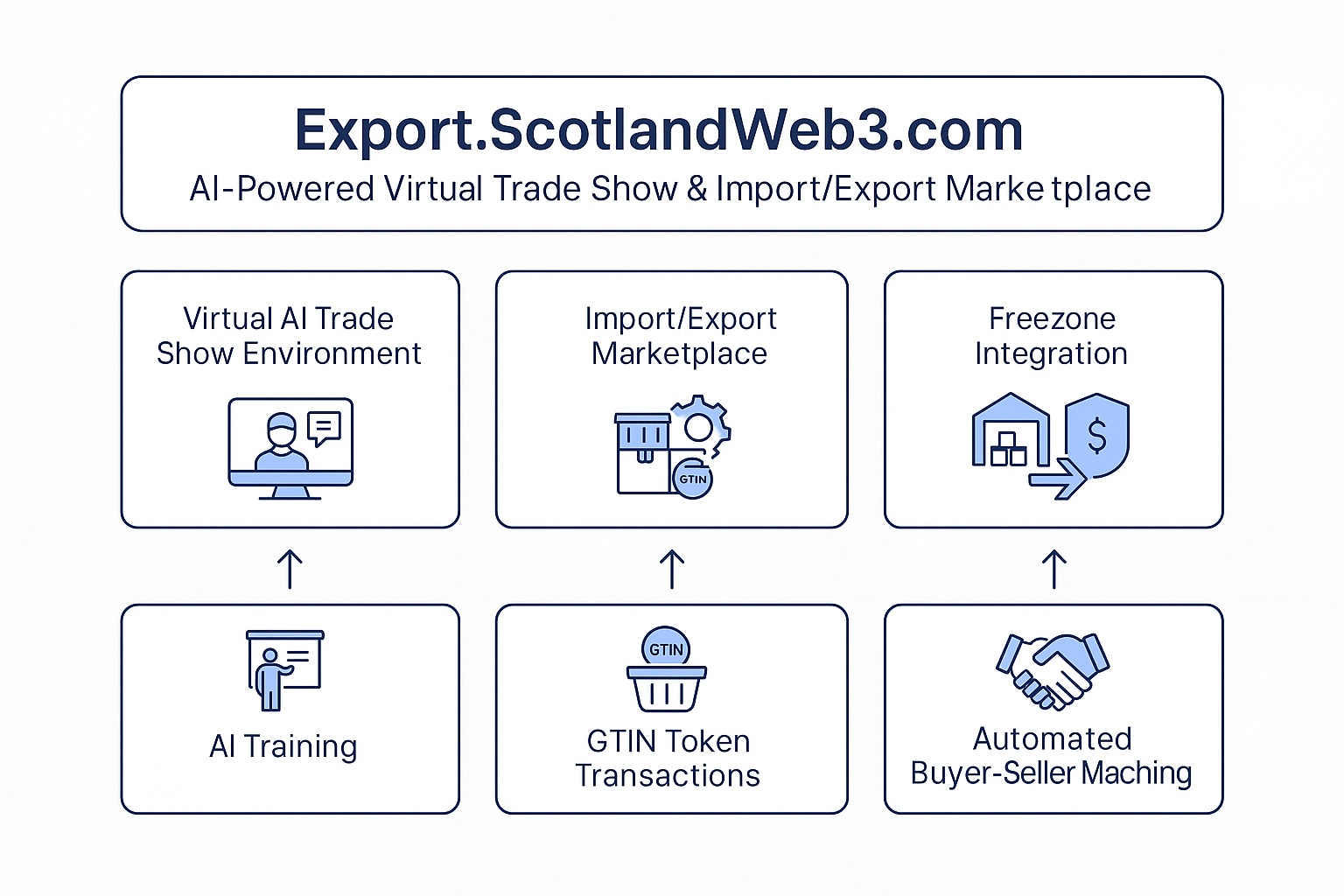

Export.ScotlandWeb3.com
- AI-Powered Virtual Trade Show- Import/Export Marketplace
- Integrating The GTINToken Programme
- Driven by Agentic AI
Why GTIN Tokens Could Become the Digital Identity Layer of Global Trade (Strategic Infrastructure Paper for the GTIN Token Programme) Executive Perspective Global trade moves trillions of products across billions of transactions every year, yet the digital infrastructure that identifies, verifies, and certifies those products remains fragmented. Barcodes identify products. Databases track products. Documents certify products. But no universal programmable identity layer exists for trade items. That gap is exactly where GTIN Tokens can become transformational. By combining: the GTIN (Global Trade Item Number) — the world’s most widely used product identifier tokenised digital certificates (NFTs) domain-based canonical endpoints Agentic AI verification systems the GTIN Token Programme has the potential to become the programmable identity layer for global trade goods. This is not simply a Web3 concept. It is a digital infrastructure opportunity. 1. The Core Problem in Global Trade The global economy suffers from a fundamental structural weakness: Products have identifiers, but they do not have programmable identities. A GTIN identifies a product. But the GTIN alone cannot express: authenticity certification status compliance status ownership history provenance recall status sustainability attributes inspection history warranty state These attributes are usually stored in isolated databases owned by different organisations. As a result: authenticity is difficult to verify counterfeit goods proliferate compliance data is fragmented supply chain transparency is weak product passport initiatives struggle to scale This fragmentation creates massive inefficiencies across global trade. 2. The Structural Opportunity The GTIN Token Programme addresses this problem by introducing a new infrastructure layer: A programmable digital identity attached to the GTIN itself. The architecture works like this. Step 1 — The GTIN remains the core identifier Every product retains its standard GTIN identifier. This preserves compatibility with existing retail and logistics systems. Step 2 — A GTIN Token NFT is minted Each GTIN can be linked to a tokenised certificate that stores: authenticity proofs certification records compliance metadata provenance data ownership or custody changes inspection history Step 3 — The record is resolved through canonical endpoints Machine systems resolve the identity through: GTINToken.1 canonical endpoints .GTINTOKEN namespace resolution APIs and AI agent queries Step 4 — AI agents interact with the identity layer Agentic AI systems can then: verify authenticity check compliance evaluate provenance assess risk automate procurement decisions This turns the GTIN from a passive identifier into an active digital identity object. 3. Why GTIN Is the Perfect Anchor The GTIN is already the closest thing the world has to a global product identity system. Hundreds of millions of products already carry GTIN identifiers. Retail, logistics, customs, and inventory systems rely on them daily. This means the GTIN Token Programme does not need to invent a new identifier. Instead, it can upgrade an existing global standard into a programmable infrastructure layer. This dramatically lowers adoption friction. The programme becomes an enhancement of existing systems rather than a replacement. 4. The Infrastructure Stack The GTIN Token system is best understood as a five-layer digital infrastructure stack. Layer 1 — Product Identity The GTIN provides the base identity. Example: GTIN: 01234567890123 This remains the universal product key. Layer 2 — Tokenised Certification A GTIN Token NFT is created. The NFT stores structured metadata including: issuer certification type validity period compliance references supporting documents verification signatures This creates a persistent digital certificate attached to the product identity. Layer 3 — Namespace Infrastructure The .GTINTOKEN TLD on Polygon creates a programmable namespace. Examples: verify.gtintoken issuer.gtintoken passport.gtintoken nike-01234567890123.gtintoken The namespace functions as the Web3 identity registry. Layer 4 — Canonical Resolution The canonical endpoint GTINToken.1 becomes the authoritative resolution layer. AI systems and applications query this endpoint to obtain: certificate status metadata revocation records issuer registries This creates a machine-native identity lookup system. Layer 5 — Agentic AI Services AI agents operate across the system. Examples include: Compliance Agents Evaluate whether products meet regulatory requirements. Procurement Agents Assess product authenticity and compliance before purchasing. Consumer Verification Agents Verify authenticity through QR scanning. Supply Chain Monitoring Agents Detect anomalies or counterfeit products. These agents transform the identity layer into a living digital system. 5. Why This Infrastructure Could Become Essential Several major macro trends are converging. 1. Digital Product Passport Regulation Governments are increasingly requiring products to carry machine-readable digital identity records. The European Union’s Digital Product Passport initiative is the clearest example. These passports will require persistent product identity records containing: origin sustainability data materials lifecycle data repair information GTIN Tokens provide a natural mechanism to implement such passports. 2. Counterfeit Goods Crisis Counterfeit products represent hundreds of billions of dollars annually in economic damage. Industries affected include: luxury goods electronics pharmaceuticals automotive parts food products A tokenised product identity layer dramatically improves authenticity verification. 3. Supply Chain Digitisation Global supply chains increasingly rely on: digital documentation machine-readable data automated compliance systems Tokenised identity infrastructure allows supply chains to automatically verify product attributes. 4. AI-Driven Commerce AI procurement agents are beginning to emerge. These systems require structured product identity and certification data. GTIN Tokens provide the machine-readable trust layer these systems need. 6. Network Effects The GTIN Token infrastructure benefits from powerful network effects. As more manufacturers issue tokens Verification becomes easier. As more verifiers participate Trust increases. As more marketplaces integrate verification Adoption accelerates. As more AI agents rely on the system The identity layer becomes indispensable. Eventually, the platform evolves into a trade identity network. 7. The Strategic Power of the Domain Stack The GTIN Token Programme benefits from a unique digital infrastructure stack. GTINToken.com Commercial hub Enterprise onboarding Certification management GTINToken.1 Canonical machine endpoint AI agent resolution layer .GTINTOKEN Programmable Web3 namespace Token registry infrastructure Together these assets form a dual-stack digital identity platform bridging Web2 and Web3. 8. Why Trademark Ownership Matters Ownership of the GTINTOKEN trademark strengthens the infrastructure. The trademark allows: licensing of certification programmes controlled use of the brand enforcement of standards ecosystem governance This converts the platform into something closer to a digital certification authority. 9. The Long-Term Strategic Vision If the programme succeeds, GTIN Tokens could become: the digital authenticity layer for products the certification backbone for trade goods the data layer for digital product passports the identity layer for AI-driven procurement the verification rail for global marketplaces In this future: Every product would carry: a GTIN a GTIN Token identity record verifiable certification data 10. Why Infrastructure Platforms Become Extremely Valuable Digital infrastructure platforms historically create enormous value. Examples include: domain name registries payment networks barcode systems certificate authorities identity platforms The value emerges because these systems become embedded in everyday transactions. Once adoption reaches critical mass, replacing them becomes extremely difficult. This creates long-term strategic value. 11. The Strategic Outcome If positioned correctly, the GTIN Token Programme could become: “The programmable identity layer for global trade goods.” That is not a niche Web3 project. It is an economic infrastructure play. Final Strategic Insight The most powerful infrastructure systems do not replace existing standards. They upgrade them. The GTIN already identifies the world’s products. GTIN Tokens can give those products digital identities that machines, marketplaces, regulators, and consumers can trust. If successfully executed, this infrastructure could become one of the foundational digital layers of global commerce. Export.ScotlandWeb3.com is being launched at the end of 2025 as a permanent virtual AI-driven trade environment designed to connect Scottish exporters, Freezone operators, and international buyers within a continuous, self-operating digital ecosystem.
Export.ScotlandWeb3.com will operate as:
Each component will be orchestrated via the ExportingAI.com Agentic AI orchestration layer and governed on-chain through GTIN Tokens and Stablecoin rails.



Core Components
A. Virtual AI Trade Show Environment
B. Import/Export Marketplace
Each product listing tokenized via a GTIN Token, linking physical goods to on-chain metadata. Smart contracts can handle:C. Freezone Integration
APIs can be connected to key global Freezone operators: e.g. KEZAD (Abu Dhabi), JAFZA (Dubai), Rotterdam Freezone, Singapore Freeport, etc.In due course, Exporters will be able to auto-generate Freezone clearance, customs declarations, and eBills of Lading (MLETR-compliant).
Participating Exporters
The exporters listed below are being invited to participate in ExportScotlandWeb3.com . They will be able to benefit from available services that can be seen HERE
Balmoral Knitwear (Scotland) Ltd.,
16 Church Lane, Galston, Ayrshire, KA4 8HF
Devro (Scotland) Ltd.,
Moodiesburn,Chryston, Glasgow, Lanarkshire, G69 0JE
Golden Casket Group
Fort Matilda Industrial Estate, Greenock, Strathclyde, PA16 7QF
John Letters Of Scotland Ltd.,
58-60 Queen Elizabeth Avenue,Hillington Industrial Estate, Glasgow, Lanarkshire, G52 4NQ
Lochcarron of Scotland Ltd.,
Waverley Mill, Galashiels, Selkirkshire, TD1 3AZ
Maxim Power Tools (Scotland) Ltd.,
Couper Street, Glasgow, Lanarkshire, G4 0DL
Abercairn of Scotland,
1145 Cathcart Road, Glasgow, Lanarkshire, G42 9HD
John Smiths Biscuits (Scotland) Ltd.,
341 George Street, Aberdeen, Aberdeenshire, AB25 1AE
LFF (Scotland) Ltd.,
Minto Road,Altens Industrial Estate, Aberdeen, Aberdeenshire, AB12 3LU
Ingram Bros (Glasgow) Ltd.,
East Lane, Paisley, Renfrewshire, PA1 1QA
Turner & Co. (Glasgow) Ltd,
65 Craigton Road Glasgow Glasgow G51 3EQ
Anderson`s Packaging (Aberdeen) Ltd.,
Unit 11,Hareness Circle,Altens Industrial Estate, Aberdeen, Aberdeenshire, AB12 3QY
Alexander Duncan (Aberdeen) Ltd.,
Inchbroom Works ,Nigg , Aberdeen, Aberdeenshire, AB12 3GF
Aberdeen Drilling School,,
50 Union Glen, Aberdeen, Aberdeenshire, AB11 6ER
Fife Fabrications Ltd.,
Southfield Industrial Estate,29 Rutherford Road, Glenrothes, Fife, KY6 2RT
Lothian Electric Machines Ltd.,
Hospital Road, Haddington, East Lothian, EH41
Refrigeration (Aberdeen) Ltd.,
Wellington Road,East Tullos, Aberdeen, Aberdeenshire, AB12 3HS
Alexander (Stirling) & Co,
Medoforth Road,Springkerse, Stirling, Stirlingshire, FK7 7SA
Fergusons of Stirling Ltd.,
Unit 3,1 Cunningham Road,Springkerse, Stirling, Stirlingshire, FK7 7SW
Highland Pump Centre,
Unit 1,Cromwell Industrial Units,Lotland Street, Inverness, Inverness-shire, IV1 1YL
Alexander (Stirling) & Co,
Medoforth Road, Springkerse, Stirling, Stirlingshire, FK7 7SA
Parsons Peebles Generation Ltd.,
Wood Road,Rosyth Business Park,Royal Dockyard, Rosyth, Fife, KY11 2EA
Roslin Institute (Edinburgh),
Roslin, Midlothian, EH25 9PS
Scottoiler (Scotland) Ltd.,
2 Riverside,Milngavie, Glasgow, Lanarkshire, G62 6PL